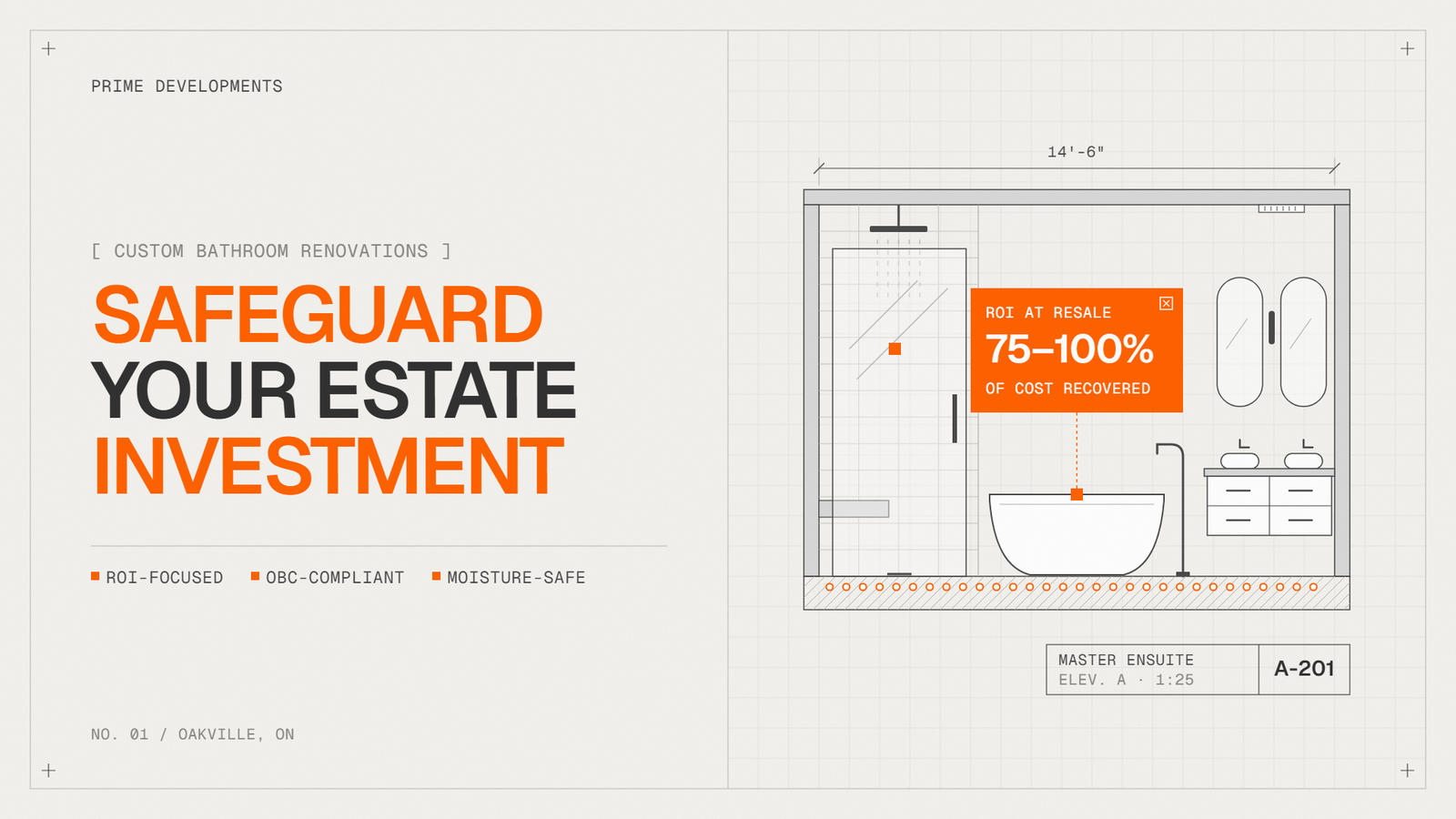
A six-figure bathroom renovation in an Oakville estate is more than a design choice. It is a significant capital investment that requires rigorous risk management. In the Greater Toronto Area, the main reason for high-end remodels is often protecting equity, not just looks. While a modern look is expected, the technical work decides if the project adds long-term value. Otherwise, it may become a liability. This guide explains ROI goals. It covers moisture protection standards. It also shares buying strategies. These tips can help protect your estate’s value during renovation.
The financial math of Oakville bathroom renovations
For high-net-worth homeowners, bathroom renovations serve as a primary equity protection strategy. Data suggests that high-end renovations in Oakville typically recover 75% to 100% of their cost at resale. This makes the bathroom one of the most reliable investment hedges against market volatility.
This is true as long as the work meets the Diamond-tier standards expected in the region. Recent homeowner sentiment data shows that pride in owning a home stays high. But many owners worry more about the cost of interior system failures. Homeowners often find that kitchen remodeling services in Oakville can similarly boost property equity. When done with the same precision, results are comparable.
ROI expectations for estate homes
In the luxury segment, a bathroom is a reflection of the property's overall maintenance and quality. Buyers in Oakville prioritize mechanical integrity and premium finishes. A renovation that integrates smart technology and superior waterproofing can prevent major structural failures that often plague older estates.
This ensures the property remains competitive in the luxury market. Avoiding routine upkeep oversights during the early build phase prevents small errors. These errors can cause long-term structural damage. Many homeowners in Oakville choose high-end bathroom renovations. They want design ideas. They also want their homes to match current city trends.
Primary cost drivers in luxury remodels
- Custom Glass and Stone: Oversized steam shower enclosures and book-matched marble slabs require specialized fabrication.
- Heated Flooring Systems: Hydronic or electric radiant heating integrated with smart thermostats.
- Estate-Scale Fixtures: High-flow rain heads and freestanding soaking tubs that require structural floor reinforcement.
- Advanced Lighting: Layered lighting schemes including cove, task, and waterproof shower LEDs.
Risk management through Ontario Building Code compliance
Technical precision in moisture protection is non-negotiable for renovations in Oakville due to the waterfront climate. High humidity levels and significant temperature changes near Lake Ontario place immense stress on buildings. Following strict Ontario Building Code (OBC) standards is the only way to prevent rot and mold. These issues can damage the structure and reduce an estate’s value.
While new build performance benchmarks often show higher initial proactive maintenance, existing estate renovations must match these standards to ensure disaster readiness. Every surface requires protection, not just the splash zones. A professional bathroom renovation must account for these environmental factors to be successful.
Moisture protection and waterfront climate
Effective moisture management requires a multi-layered approach. This includes the installation of high-performance vapor barriers and waterproof membranes behind every tiled surface. Proper ventilation systems must be sized correctly for the room's volume.
Charles Eames spent a career arguing that this category of work is not subordinate to the design:
"The details are not the details. They make the design."
Charles Eames
He elaborated on it elsewhere in terms that fit a wall assembly precisely: it is the connections that give a product its life. In a bathroom, the connections are the lapped seams of the membrane, the transition where the cement board meets the framing, and the joint between the vapour barrier and the vent.
None of that survives into the finished room. The homeowner sees book-matched marble and a steam enclosure, and judges the work on those. But the marble is only as lasting as the layer behind it. That layer is the only part of the renovation you cannot fix later. To fix it, you must remove everything in front of it.
This is the practical reason to treat specification as part of the design rather than as site work handled after the drawings are signed.
